The AI prompts that produce the best room makeover results in 2026. Copy-ready templates for living rooms, bedrooms, kitchens, and more, tested inside Spacely AI.
A good AI prompt is the difference between a room render that looks like a stock photo and one that looks like the space you actually pictured. Most designers who start using generative AI for interior work discover this within the first few projects: the tool is only as helpful as the prompt guiding it.
This guide covers what makes a room makeover prompt work, the structure the strongest prompts share, and 12 copy-ready templates for the room types that come up most in real projects. Each template is written to work inside Spacely AI, and each is annotated with what to adjust when you want a different result. Bookmark this page as a reference; the prompts are designed to be reused and remixed across projects.
What makes a room makeover prompt work
The strongest AI prompts for interior design share a consistent structure. After hundreds of prompt tests inside Spacely AI, four elements show up in almost every high-quality output:
- The room type: the specific space being rendered (living room, primary bedroom, galley kitchen, powder room)
- The design style: the visual direction (Japandi, mid-century modern, coastal, transitional)
- Key materials and finishes: what the surfaces are made of (white oak flooring, matte black hardware, linen upholstery)
- Lighting and mood: the atmosphere (warm afternoon light, soft ambient evening glow, north-facing morning light)
Living room makeover prompts
Living rooms are the most-searched room type for interior AI prompts and the most versatile in terms of style range. Below are five templates covering the styles most requested by clients in 2026.
- Scandinavian minimalist
"Modern Scandinavian living room, white walls, light oak flooring, cream boucle sofa, black steel floor lamp, indoor plants, natural daylight from tall windows."
- Warm mid-century modern
"Mid-century modern living room, walnut wood details, mustard yellow velvet sofa, brass accents, geometric area rug, warm evening lamp light."
- Contemporary luxe
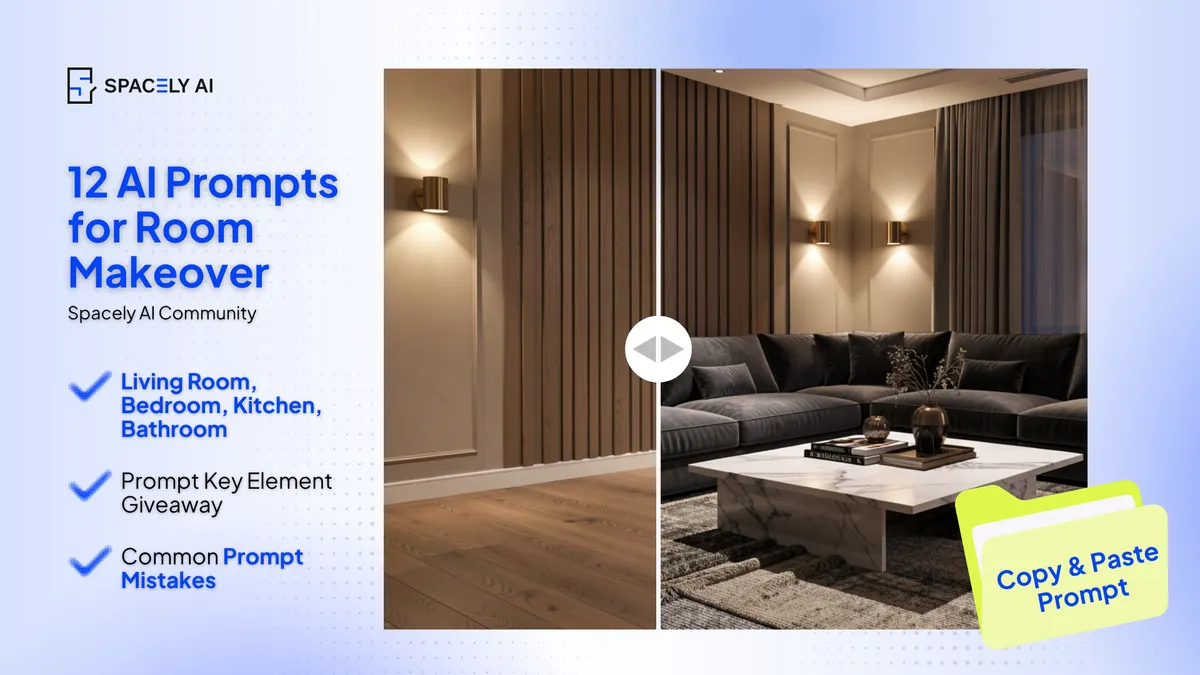
"Contemporary luxury living room, charcoal grey velvet sectional, marble coffee table, brushed brass sconces, layered wool rug, warm ambient evening light."
How to adjust these: Swap the sofa color, the flooring, or the lighting time to move the same style toward a different mood. The bones of each prompt stay the same.
Bedroom makeover prompts
Bedrooms respond well to prompts that emphasize atmosphere over feature count. Fewer objects, more mood cues, tends to produce stronger renders.
- Primary bedroom, warm minimalist
"Primary bedroom in warm minimalist style, oak headboard, cream linen bedding, black metal pendant lights, soft morning light, calm and quiet."
- Guest bedroom, transitional
"Guest bedroom, transitional style, upholstered headboard in taupe, neutral bedding, brass sconces, warm evening light, welcoming atmosphere."
- Kids' bedroom, modern playful
"Kids' bedroom, modern playful style, white walls with soft pastel accent wall, low-profile bed, natural wood furniture, plush rug, bright afternoon light."
Kitchen makeover prompts
Kitchens are the most-searched room type after living rooms in the 2026 query data. They also carry the most technical specificity, which means the prompts benefit from naming appliances, cabinetry, and countertop materials directly.
- Modern white kitchen
"Modern white kitchen, shaker cabinets, white marble countertops, matte black hardware, brass pendant lights over island, natural daylight."
- Warm wood kitchen
"Warm wood kitchen, walnut cabinets, cream quartz countertops, brass hardware, open shelving, pendant lights over island, warm afternoon light."
- Bold blue kitchen
"Modern kitchen with navy blue lower cabinets and white upper cabinets, brass hardware, white marble countertops, subway tile backsplash, warm pendant lighting."
A note on color specifics: Prompts that name a specific color (navy blue, sage green, terracotta) produce more predictable results than prompts that say "colorful" or "vibrant."
Bathroom makeover prompts
Bathrooms are prompt-sensitive because small material choices define the whole space. The most successful bathroom prompts name the tile, the fixture finish, and the lighting direction.
- Modern spa bathroom
"Modern spa bathroom, large-format porcelain tile floors, floating vanity in walnut, matte black fixtures, walk-in shower with glass surround, warm ambient lighting."
- Powder room, jewel box
"Powder room, jewel box style, deep green painted walls, marble sink, brass hardware, gold-framed mirror, moody wall sconces, evening ambient light."
- Primary bathroom, contemporary
"Primary bathroom, contemporary style, marble tile floors, freestanding tub, double vanity with brass hardware, walk-in shower, natural daylight through skylight."
Common prompt mistakes to work around
Three patterns come up repeatedly in prompt tests. Avoiding them typically improves the first render:
- Naming too many objects. A prompt with fifteen specific items tends to produce a cluttered render. Focus on three to five key elements and let the AI fill in the rest.
- Using contradictory style words. "Minimalist maximalism" or "cozy industrial luxury" tend to confuse the render. If you want a hybrid style, pick one as the primary and use the other as an accent modifier: "industrial style with cozy warm accents" reads more clearly than "cozy industrial style."
- Forgetting the lighting cue. Prompts without a lighting or mood note tend to produce flat renders. Even a short phrase like "soft daylight" or "warm ambient evening" meaningfully improves the output.
FAQ
How many objects should I name in an AI room prompt? Three to five key elements produce the most consistent results. Prompts that name fifteen or more specific objects tend to produce cluttered or overpacked renders because the AI tries to fit each item into the frame. Naming three to five anchor pieces (the sofa, the flooring, the lighting) and letting the AI fill in supporting details typically works better.
Should I write prompts in full sentences or keyword lists? Both formats work, but full sentences tend to produce more coherent renders because they preserve the relationships between elements. A keyword list like "modern living room, oak floor, cream sofa, brass lamp" will render, but a full sentence with the same information gives the AI a clearer picture of how the elements relate to each other.
More design workflow insights on the Spacely AI blog →
Get started
→ Create your free account
→ Watch the full tutorial on YouTube
→ Explore the member plan
For more information and media inquiries, please contact
Website: spacely.ai
Facebook: facebook.com/spacelyai
Instagram: instagram.com/spacely.ai
Email: [email protected]