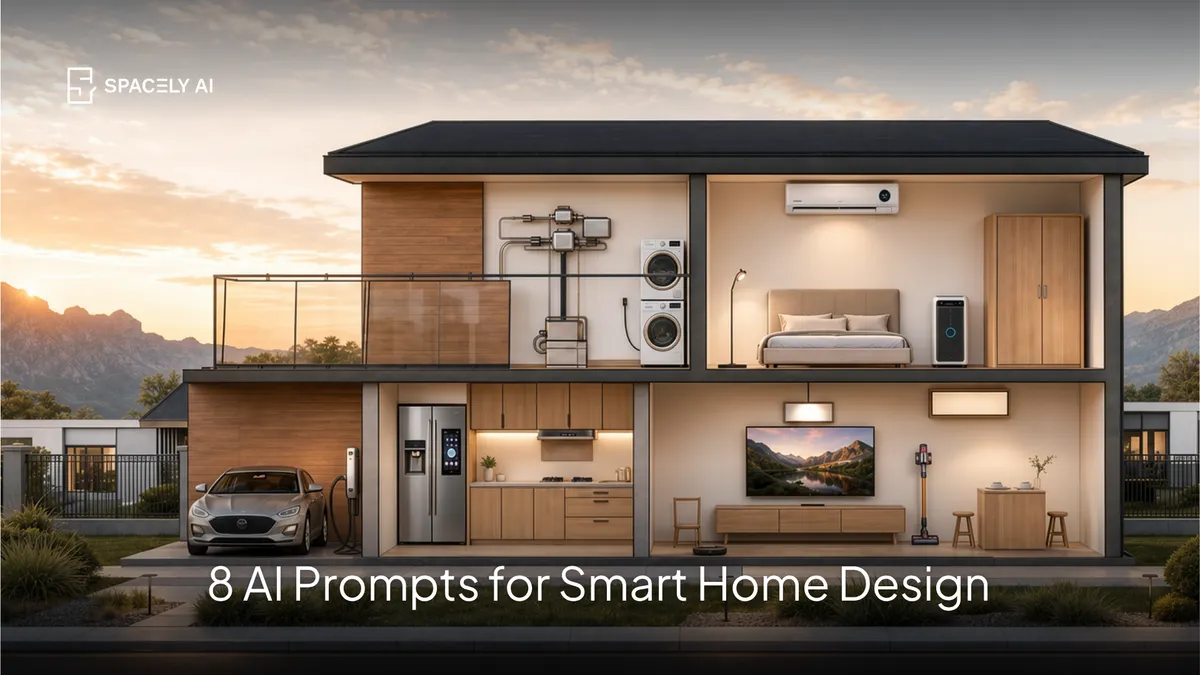
Copy-paste AI prompts for smart home design: connected living rooms, bedrooms, kitchens, and home theaters. Each shows smart tech integrated cleanly, not cluttered.
A good smart home design prompt names five things: the room, the smart features shown discreetly, a clean modern look, the materials and lighting, and the camera. The whole point of smart home design is that the technology enhances the space without cluttering it — so the render should show layered smart lighting and connected features integrated cleanly, with the hardware kept out of sight.
Naming the smart lighting scenes and discreet integration is what makes the render read as a genuine smart home rather than just a modern room. Start from a photo of the space (or a model view) so the layout holds, then let the prompt set the look.
Below are copy-paste smart home prompts by room, plus the structure to adapt them. Spacely AI renders from your photo in about 60 seconds.
What makes a good smart home design prompt?
Name the room, the discreet smart features, and a clean look.
| Element | Specific (smart home) |
|---|
| Room | "connected living room" / "smart bedroom" |
| Smart features | "layered smart lighting, hidden speakers, discreet controls" |
| Look | "clean, modern, uncluttered" |
| Materials & light | "warm oak, matte finishes, integrated LED lighting scenes" |
| Camera | "eye-level, wide-angle" |
Which smart home prompts can you copy?
Pick the room and adjust the materials.
- Smart living room:
"modern smart living room, layered integrated lighting with a warm evening scene, hidden speakers, a discreet wall control panel, clean matte media unit, warm oak and neutral palette, uncluttered, eye-level wide-angle."
- Smart bedroom:
"smart bedroom, soft integrated ambient lighting, discreet blackout blinds, minimal bedside controls, warm neutral palette, clean and calm, evening scene, wide-angle."
- Smart kitchen:
"smart kitchen, handleless cabinets, integrated appliances, under-cabinet LED lighting, discreet controls, clean modern look, warm daylight, wide-angle."
- Home theater:
"smart home theater, tiered seating, acoustic paneling, integrated ambient lighting, a large screen, warm low lighting, immersive and clean, eye-level."
- Smart home office:
"smart home office, integrated task and ambient lighting, clean cable-free desk, discreet tech, warm oak and matte finishes, bright natural light, uncluttered, eye-level."
- Connected entryway:
"smart entryway, integrated lighting, a discreet control and security panel, clean floating storage, warm materials, welcoming, wide-angle."
- Smart bathroom:
"smart bathroom, backlit mirror, integrated lighting scenes, heated floor, discreet controls, warm stone and wood, spa-like and clean, wide-angle."
- Smart open-plan living:
"smart open-plan living and kitchen, cohesive integrated lighting throughout, hidden tech, clean modern palette, warm evening scene, wide-angle."
How do you show smart tech without clutter?
Integrate it and light it well. The mark of good smart home design is that you feel the technology working without seeing the hardware. So in your prompt, emphasize integration — "hidden speakers," "discreet controls," "integrated lighting" — rather than visible gadgets, and lead with smart lighting, since layered, scene-based lighting is the most visible and evocative smart feature. Keep the look clean and uncluttered, because clutter undermines the whole idea. Show a specific lighting scene (a warm evening mood, say) to make the "smart" aspect read. Starting from a photo of the actual room keeps the layout true, so you're designing your smart home, not a generic one.
FAQ
How do you write an AI prompt for a smart home? Name the room, the smart features shown discreetly (integrated lighting, hidden speakers, discreet controls), a clean modern look, the materials, and a specific lighting scene. Lead with smart lighting since it's the most visible feature, keep the look uncluttered, and start from a photo of the room so the layout stays true.
How do you show smart technology in a render without clutter? Emphasize integration rather than visible gadgets: "hidden speakers," "discreet controls," "integrated lighting," and lead with layered, scene-based smart lighting, which is the most evocative smart feature. Keep the space clean and uncluttered, since that's the essence of good smart home design.
Can AI design a smart home from a photo? Yes. Upload a photo of the room to Spacely AI, apply a smart home prompt, and it restyles the actual space while keeping the layout, so you're visualizing your home, not a generic one. Use Point & Edit to adjust individual elements like the lighting scene or media unit.
More design workflow insights on the Spacely AI blog →
Get started
→ Create your free account
→ Watch the full tutorial on YouTube
→ Explore the member plan
For more information and media inquiries, please contact
Website: spacely.ai
Facebook: facebook.com/spacelyai
Instagram: instagram.com/spacely.ai
Email: [email protected]