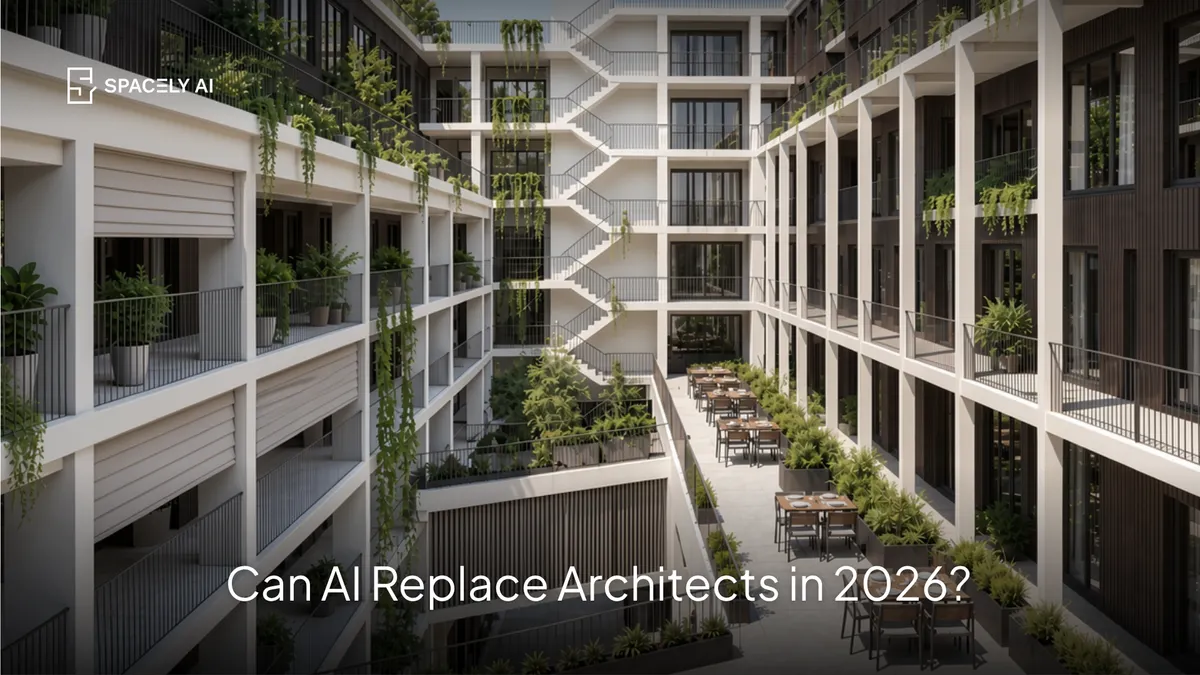
Can AI replace architects? In 2026, no. AI has mastered rendering speed, but not the judgment, responsibility, and creativity architecture demands. Here's why.
The rapid rise of AI in architecture has sparked a real debate: will technology eventually make the professional architect obsolete? In 2026, the answer is a clear no. AI has mastered the speed of rendering and visualization, but it cannot replicate the judgment, responsibility, contextual understanding, and creative problem-solving that a human architect brings to a building.
Architects are using AI to handle the visual heavy lifting such as generating photorealistic concepts in about 60 seconds, which frees them to focus on the decisions that actually shape a project, and that someone has to be accountable for. AI renders the design; the architect is responsible for it.
What can't AI replace in architecture?
The parts of the job that carry consequences. A building is not just a striking image. It's a structure people live and work in, bound by site, budget, code, safety, and human need. AI can follow a prompt for a "modern concrete house," but it can't weigh how the building meets its site, how it will be used over decades, how it responds to climate and community, or whether it's safe and buildable.
AI can't take professional responsibility for any of that. Those judgments from technical, ethical, contextual, t0 creative are the core of what an architect does, and they don't reduce to a prompt. AI produces options; the architect decides which one is right and stands behind it.
How do architects actually use AI?
As a high-speed co-pilot, not a replacement. Rather than replacing architects, AI is becoming the fastest assistant they've ever had. With AI rendering, an architect can visualize dozens of design directions in the time it once took to produce a single render, test materials and massing in minutes, and put a photorealistic concept in front of a client the same day.
That doesn't replace design thinking. It scales it, and it removes the slow production work that used to eat into the time architects would rather spend designing. Meanwhile, the technical backbone stays where it belongs: BIM and CAD remain authoritative for documentation and anything buildable. AI handles the pixels; the architect handles the building.
Will AI replace architects in the future?
No, it changes the tools, not the role. Every major tool shift in architecture from hand-drafting to CAD to BIM changed how architects work without removing the need for architects. AI is the next of these. It makes visualization faster and more accessible, but the responsibility for a safe, functional, meaningful building still rests with a licensed professional exercising judgment.
The architects who thrive in 2026 aren't the ones who fear AI or ignore it — they're the ones who use it to move faster on the visual work and spend more of their time on the judgment only they can provide.
The bottom line
Can AI replace architects? No. It has mastered rendering speed, but not the judgment, accountability, context, and creativity that architecture demands. The winning architects in 2026 marry human vision with technological speed: AI handles the rendering, and the architect handles the responsibility. Used that way, AI doesn't threaten the profession — it gives architects more time to be architects.
FAQ
Can AI replace architects? No. AI can render designs quickly and explore many options, but it can't provide the professional judgment, accountability, contextual understanding, and creativity a building requires —or take responsibility for a safe, buildable result. Architects use AI to speed up visualization while the design decisions stay with them.
How do architects use AI in 2026? Mostly for visualization and concept exploration; generating photorealistic renders in about 60 seconds, testing materials and massing, and presenting to clients faster. It scales their design thinking rather than replacing it, while BIM and CAD stay authoritative for documentation and anything buildable.
Will AI make architects obsolete? No. Like CAD and BIM before it, AI changes the tools without removing the need for the architect. The responsibility for a safe, functional, meaningful building stays with a licensed professional. Architects who use AI gain an edge; the role itself remains essential.
More design workflow insights on the Spacely AI blog →
Get started
→ Create your free account
→ Watch the full tutorial on YouTube
→ Explore the member plan
For more information and media inquiries, please contact
Website: spacely.ai
Facebook: facebook.com/spacelyai
Instagram: instagram.com/spacely.ai
Email: [email protected]