How to prompt a modern-style room for any space: bedroom, living room, kitchen, bathroom, garage. Reuse the modern vocabulary, adapt per room, keep it consistent.
"Modern" is a style with a consistent vocabulary: clean lines, uncluttered space, a neutral palette, and natural materials. Prompting a modern room, whatever the room, comes down to naming that vocabulary and then adapting it to the space. A modern bedroom, kitchen, bathroom, and even garage all share the same DNA: low-profile forms, matte finishes, warm neutrals, and hidden storage.
What changes is only what fills each room. That's the key to a consistent modern look across a whole home; keep the shared style words the same in every prompt, and swap just the room-specific pieces. Add your materials, the light, and a camera angle, and start from a photo of the actual room so the layout carries through.
Below: the modern vocabulary to reuse everywhere, a copy-paste prompt for each room type, and how to keep the style consistent from room to room. One rule throughout: name real materials like "matte white cabinets, oak, black steel," because "modern" on its own renders generic.
What defines a "modern" prompt?
A shared set of words you can reuse in any room. Modern style is built on a few consistent traits: clean, straight lines; a minimal, uncluttered feel; a neutral palette of warm whites, greige, and wood with black accents; natural materials like oak, stone, and matte metal; low-profile furniture; and details like handleless fronts and hidden storage.
Put those words in every prompt and you've set the style; then you only need to describe what belongs in the specific room. It also helps to name what to avoid — modern isn't ornate, glossy, or busy.
| Aspect |
Modern words to use |
Avoid |
| Lines & forms |
Clean, straight, low-profile |
Ornate, heavily curved, bulky |
| Palette |
Warm white, greige, wood, black accents |
Bright clashing colors |
| Materials |
Oak, stone, matte metal, glass |
Glossy plastic, heavy patterns |
| Details |
Handleless, hidden storage, minimal |
Fussy trim, clutter |
Apply a modern style to your own room
How do you prompt a modern room, by room type?
Reuse the modern words above, then add each room's specifics.
- Modern bedroom:
"modern bedroom, clean lines, low platform bed, warm greige walls, oak floor, matte black accents, hidden storage, soft morning light, eye-level wide-angle."
- Modern living room:
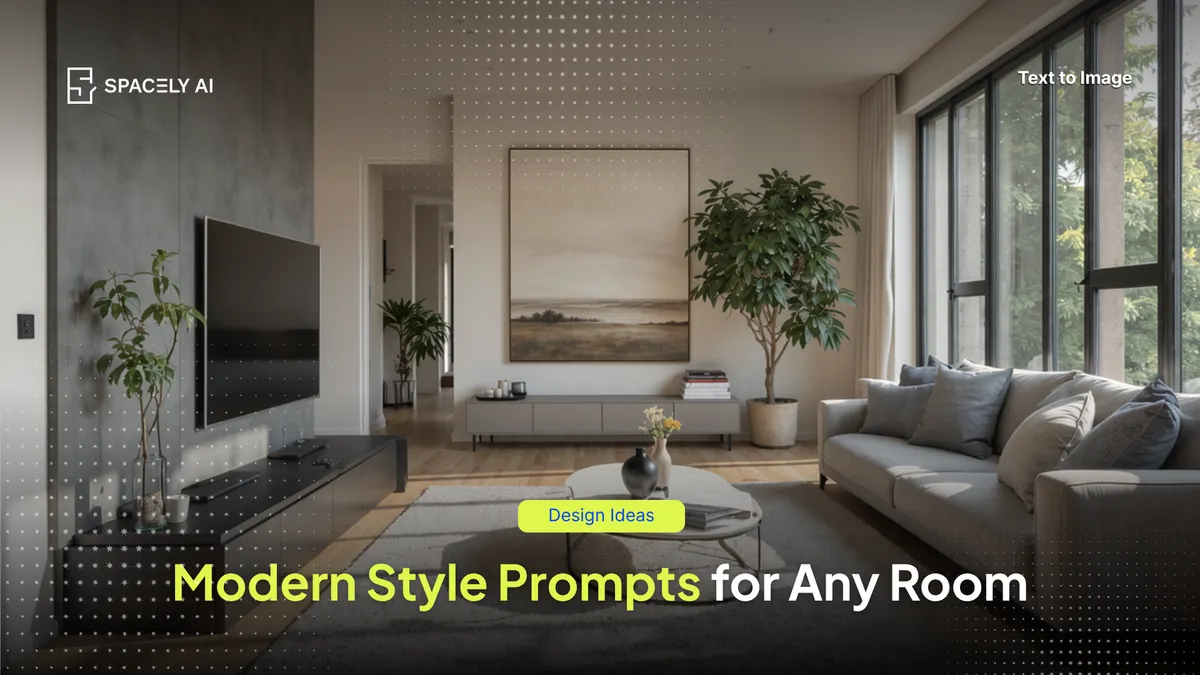
"modern living room, low-profile grey sofa, oak floor, warm neutral palette, matte black media unit, minimal styling, large windows, bright daylight, wide-angle."
- Modern kitchen:
"modern kitchen, handleless matte white cabinets, oak island, honed stone counters, integrated appliances, black steel fixtures, clean lines, soft daylight, wide-angle."
- Modern bathroom:
"modern bathroom, floating vanity, matte black fixtures, large-format stone tile, frameless glass shower, warm neutral palette, clean lines, soft light, eye-level."
- Modern powder room / toilet:
"modern powder room, wall-hung toilet, floating stone vanity, matte black tapware, micro-cement walls, minimal, warm accent light."
- Modern home office:
"modern home office, clean white desk, oak shelving, warm greige walls, matte black lamp, uncluttered, bright natural light, eye-level wide-angle."
- Modern dining room:
"modern dining room, oak table, low-back neutral chairs, matte black pendant, warm neutral palette, minimal styling, soft daylight, wide-angle."
- Modern garage:
"modern garage, polished concrete floor, flat-front storage cabinets in matte grey, clean workbench, bright even lighting, uncluttered, wide-angle."
- Modern entryway:
"modern entryway, floating oak bench, hidden storage, warm greige walls, matte black hooks, large mirror, clean lines, soft daylight."
How do you keep the modern style consistent across rooms?
Reuse the same style DNA in every prompt, only change what fills the room.
The fastest way to make a whole home read as one cohesive modern space is to hold the shared elements constant: the same palette (warm white, greige, wood, black accents), the same materials (oak, stone, matte metal), the same finishes (handleless, matte, low-profile), and ideally continuous flooring throughout. Then each room's prompt only swaps its specific pieces — a bed in the bedroom, an island in the kitchen, a vanity in the bathroom. Because the style words don't change, the rooms feel designed by the same hand. When you test this on a photo of each actual room, you can see the consistency build space by space.
FAQ
How do you prompt a modern-style room in AI?
Name the modern vocabulary: clean lines, a neutral palette (warm white, greige, wood, black accents), natural materials, minimal styling, and low-profile forms. Then, add the room-specific pieces, your materials, the light, and a camera angle. Start from a photo of the actual room so the layout carries through, and name real materials rather than just "modern."
How do you keep a modern style consistent across different rooms?
Hold the shared elements constant in every prompt: the same palette, materials, and finishes, plus continuous flooring where possible. Only change what fills each room: a bed, an island, a vanity. Because the style words don't change room to room, the whole home reads as one cohesive modern design.
Can AI apply a modern style to a photo of my room?
Yes. Spacely AI renders from a photo of your actual room, so the modern style is applied to your real layout and proportions rather than a generic space. If one detail is off, use Point & Edit to adjust just that element while keeping the rest of the render.
More design insights on the Spacely AI blog →
Get started
→ Create your free account
→ Watch the full tutorial on YouTube
→ Explore the member plan
For more information and media inquiries, please contact
Website: spacely.ai
Facebook: facebook.com/spacelyai
Instagram: instagram.com/spacely.ai
Email: [email protected]