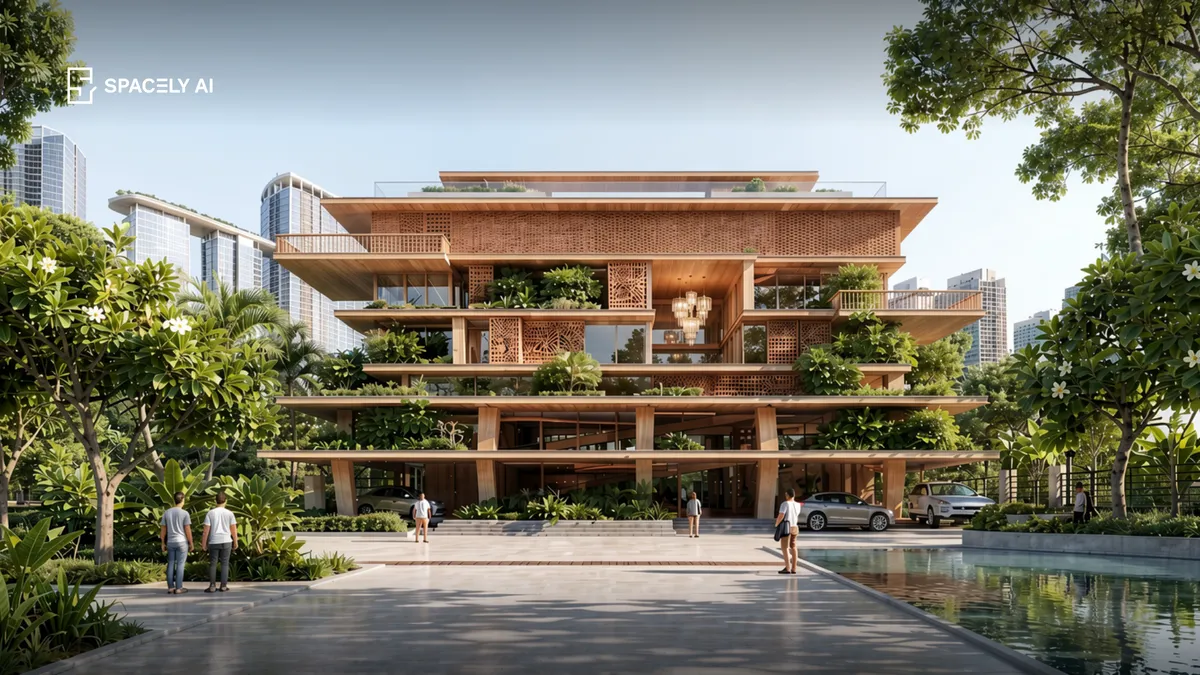
Sustainable and bioclimatic design work with the climate: orientation, shading, natural light. Here's how AI helps you visualize and iterate these ideas fast.
Sustainable building design including bioclimatic design, which works with the local climate rather than against it. It is about making a building comfortable and efficient through passive strategies before mechanical ones. A bioclimatic house uses orientation, shading, natural light, ventilation, thermal mass, and materials to stay comfortable with as little added energy as possible.
AI helps you explore and communicate these ideas quickly: you can visualize how orientation, shading devices, greenery, and materials look and work together, and iterate through options in minutes rather than days. One honest boundary up front — AI rendering helps you visualize and communicate sustainable design, but it doesn't replace proper energy modeling or performance simulation, which need dedicated tools. Used for what it's good at, though, it's a fast way to test and present the design moves that make a building bioclimatic.
Below: what bioclimatic and sustainable design involve, how AI helps, and where the line sits.
What is bioclimatic / sustainable building design?
Designing with the climate, using passive strategies first. Bioclimatic design responds to a site's specific climate so the building does much of the comfort work on its own. The core strategies are consistent:
- Orientation: positioning the building and its openings for the sun and prevailing wind
- Shading: overhangs, fins, and screens that block summer sun while letting in winter light
- Natural light: daylighting to cut electric lighting
- Natural ventilation: cross-breezes and stack effect for cooling
- Thermal mass: materials that absorb and release heat to steady temperatures
- Materials and greenery: low-impact materials, planting, green roofs
Get these right and a building is comfortable and efficient before a single mechanical system switches on, which is the heart of sustainable design.
How can AI help with sustainable design?
By letting you visualize and iterate the passive moves quickly. AI is strong at the exploratory, communicative side of sustainable design. You can render how a shading system looks and how it casts shadow across a facade at different times of day, test how orientation and glazing read, visualize green roofs and planting, and compare material options — all in about 60 seconds per render, starting from your own model.
That speed matters because sustainable design is iterative: you're weighing trade-offs between light, shade, and form, and being able to see each option quickly helps you and your client make better calls. It's also persuasive photorealistic image of a shaded, planted, daylit building communicates the intent far better than a description.
| Bioclimatic strategy | What it does | How AI helps |
|---|
| Orientation | Positions the building for sun and wind | Visualize glazing and form options |
| Shading | Blocks summer sun, admits winter light | Render shadows at different times of day |
| Natural light | Cuts electric lighting | Preview daylight in the space |
| Greenery / green roofs | Cooling, biodiversity, low impact | Visualize planting on the design |
| Materials | Low-impact, thermally suited | Compare material looks quickly |
What are the limits of AI here?
Visualization, not performance simulation. This is the important boundary: AI rendering shows you how a sustainable design looks and helps you communicate and iterate it, but it does not calculate energy use, daylight factors, thermal performance, or carbon. Those require dedicated simulation and analysis tools, and the real environmental decisions should rest on that data plus professional judgment.
Think of AI as the fast visualization and communication layer on top of a sustainable design process. It helps you explore and present the ideas, while the performance is verified with the proper tools.
FAQ
What is a bioclimatic house? A house designed to work with its local climate using passive strategies: orientation, shading, natural light, natural ventilation, thermal mass, and suitable materials. It stays comfortable and efficient with minimal added energy. It's a core part of sustainable design: let the building do the comfort work before mechanical systems.
How can AI help with sustainable building design? AI lets you visualize and iterate the passive design moves quickly, rendering shading and how it casts shadow, previewing daylight, visualizing green roofs and planting, and comparing materials, all from your model in about 60 seconds. It's excellent for exploring and communicating sustainable ideas, especially to clients.
Can AI calculate a building's energy performance? No. AI rendering visualizes how a sustainable design looks and helps you iterate it, but it doesn't calculate energy use, thermal performance, or carbon — those need dedicated simulation tools and professional judgment. Use AI for visualization and communication, and verify performance with the proper analysis tools.
More design workflow insights on the Spacely AI blog →
Get started
→ Create your free account
→ Watch the full tutorial on YouTube
→ Explore the member plan
For more information and media inquiries, please contact
Website: spacely.ai
Facebook: facebook.com/spacelyai
Instagram: instagram.com/spacely.ai
Email: [email protected]