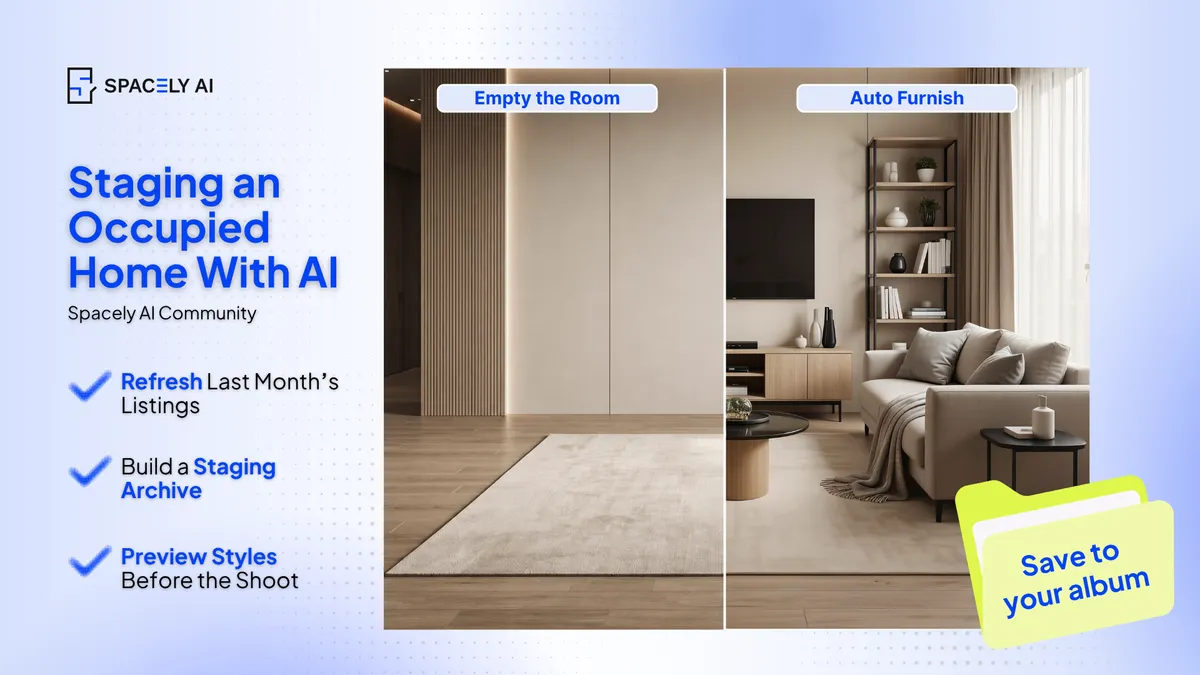
Staging a lived-in home is harder than staging a vacant one. Here's how to stage an occupied home with AI; declutter and restyle the photos, and keep it honest.
Staging an occupied home means presenting a house that people still live in; with the owner's furniture, clutter, and personal items in place, so it appeals to buyers. It's harder than staging a vacant home, because you're working around a household and its daily life rather than starting from a blank slate.
AI helps in two honest ways: it can virtually declutter, depersonalize, and restyle the listing photos so a lived-in home shows its best online, and it can give the owner and agent a visual target; a preview of the decluttered or rearranged room to actually carry out before showings.
There's one catch that matters more for occupied homes than for empty ones: buyers will walk into the real house, so the photos need to reflect what they'll actually see. That means pairing virtual editing with genuine physical decluttering, and disclosing any virtual staging. Staging is worth the effort, homes staged well tend to draw stronger offers and sell faster; and AI makes it quicker and cheaper than a full physical re-stage. Spacely AI can declutter and restyle a room straight from a photo.
What makes staging an occupied home different?
You can't empty it and start fresh, you have to edit around a life in progress. With a vacant home, you're adding furniture to a clean space. With an occupied one, the furniture, décor, clutter, and personal items are already there, and someone still needs to cook, sleep, and live while the house is on the market.
That changes the job: it's less about adding and more about editing; removing, depersonalizing, and rearranging what's already in place. And there's a constraint vacant homes don't have: because the owner lives there, the in-person showing has to hold up to the photos, so whatever a listing image promises, the real rooms need to come close to delivering.
Does staging actually help sell a home?
Yes, the data consistently points that way. According to the National Association of REALTORS, staging research, a meaningful share of agents report that staging leads to higher offers, many sellers' agents see staged homes spend less time on the market, and the large majority of buyers' agents say staging makes it easier for buyers to picture the home as their own.
In other words, staging isn't decoration; it's how a home communicates value, both online where buyers first see it and in person where they decide. For an occupied home, that starts with editing the space down so its best qualities come through.
How do you stage an occupied home with AI?
Two uses, and they work together. First, for the listing photos: AI can virtually declutter surfaces, remove personal items, and restyle a room so the online listing shows the home's potential rather than its everyday mess; a faster, cheaper alternative to a full physical re-stage.
Second, as a plan to execute: AI can preview how a room looks decluttered, rearranged, or neutralized, giving the owner and agent a clear visual target to carry out physically before showings.
- Photograph the room as it is. A clear, straight-on shot of the lived-in space.
- Declutter and depersonalize it virtually. Clear surfaces, remove personal items, and edit out excess so the room reads calm and spacious.
- Restyle if needed. Neutralize bold décor or dated finishes to widen the home's appeal.
- Use the result as a target. Have the owner physically bring the real room closer to the edited version before showings.
- Disclose virtual staging on the listing, and keep the images true to the home's actual layout and condition.
How do you keep it honest?
The rule for occupied homes is simple: the photos have to match the house. For a home sale, virtually staged or decluttered photos are widely used and accepted — as long as you disclose them. But because someone still lives in an occupied home, there's an extra duty: bring the real rooms closer to what the photos show, so buyers aren't disappointed at the door.
Use AI to plan and enhance, not to invent structural plan or show a completely different layout the home doesn't have. Handled this way, AI helps a lived-in home present at its best while keeping the listing accurate, which protects both the sale and your reputation.
FAQ
Can you virtually stage a home that's occupied?
Yes. AI can declutter, depersonalize, and restyle photos of a lived-in home so the listing shows its potential — a faster, cheaper alternative to a full physical restage. For a sale, disclose the virtual staging, and physically declutter the real rooms so the in-person showing matches the photos.
How do you stage a home you're still living in?
Edit the space down: declutter surfaces, remove personal items, deep clean, pare back excess furniture, neutralize bold décor, and maximize light. AI can help by previewing the decluttered, restyled result so you have a clear target to work toward, and by enhancing the listing photos.
Is it okay to virtually declutter listing photos?
For a home sale, yes — it's common practice, as long as you disclose it and the images represent the home's actual layout and condition. Never edit out defects or misrepresent the space. Because someone lives there, pair virtual decluttering with real decluttering so buyers get what the photos promised.
More real estate insights on the Spacely AI blog →
Get started
→ Create your free account
→ Watch the full tutorial on YouTube
→ Explore the member plan
For more information and media inquiries, please contact
Website: spacely.ai
Facebook: facebook.com/spacelyai
Instagram: instagram.com/spacely.ai
Email: [email protected]
Sources
- Highlights From the Profile of Home Buyers and Sellers — National Association of REALTORS®: buyers overwhelmingly use the internet in their home search and rate listing photos as the most useful feature of the sites they use; the 2025 report (transactions July 2024–June 2025) also notes first-time buyers at a historic low of 21% and a median buyer age of 40. Exact percentages for internet use and photo usefulness are in the full downloadable report.