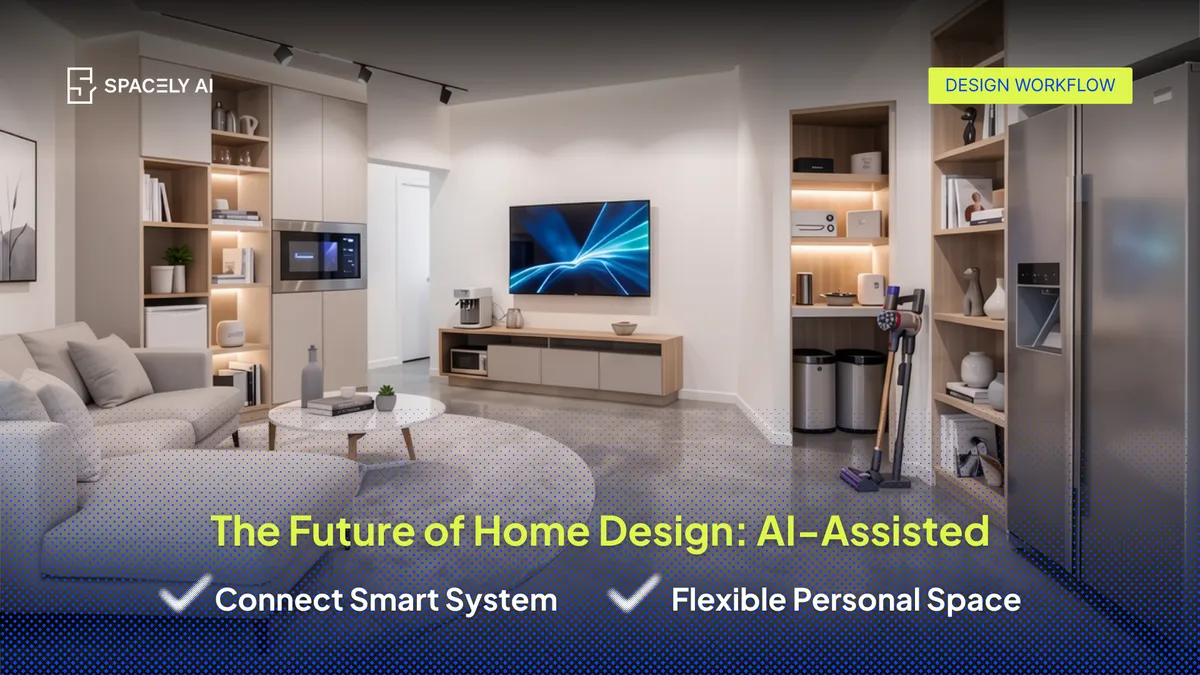
The future of home design is smarter, more sustainable, more flexible, and more personal. AI visualization lets anyone see a space before building it. Here's what's coming.
Houses are becoming more connected, with smart lighting, climate, and security responding to how people live. They're becoming greener and more biophilic, with natural materials, daylight, and energy efficiency treated as defaults rather than extras. They're becoming more flexible, with rooms that adapt to work, rest, and family life. And they're becoming more personal, tuned to individual routines rather than one-size-fits-all layouts.
Underneath all of it, the design process is shifting too: AI visualization now lets anyone see a space before it's built, so decisions are made with eyes open rather than on faith. The common thread is responsiveness — homes, and the way we design them, adapting to real life. Spacely AI is part of that shift, letting people visualize a space from a photo before committing.
What will the future of home design look like?
Connected, sustainable, flexible, and personal. Four directions are shaping what's next.
- Connected: smart lighting, climate, blinds, and security woven into the home so it responds to you.
- Sustainable and Biophilic: natural materials, daylight, greenery, and energy efficiency as standard, because they're better to live in and better for the planet.
- Flexible: spaces that adapt as needs change, with rooms doing double duty for work and life.
- Personal: homes designed around how individuals actually live, rather than generic layouts. None of these is exotic; they're already emerging, and they'll only become more the norm.
| Trend | What it means for your home |
|---|
| Connected | Smart lighting, climate, and security that respond to you |
| Sustainable & biophilic | Natural materials, daylight, and efficiency as defaults |
| Flexible | Rooms that adapt to work, rest, and family life |
| Personal | Design tuned to how you actually live |
| Visual-first | Seeing a space before it's built becomes normal |
How does the smart home fit the future?
As part of the home's design, not an add-on. The smart home of the future isn't a house full of gadgets. It's a home where connected features are designed in from the start, so the technology serves daily life quietly. Lighting shifts through the day, climate stays comfortable, and control is simple, all without the space looking like a showroom of devices.
The direction is toward technology that's felt rather than seen: the home responds to you, and the hardware stays out of the way. Smart design and good design are converging into the same thing.
How is the design process itself changing?
You can now see a space before it exists. Perhaps the biggest shift isn't in the homes but in how we design them. For most of history, deciding on a design meant imagining the result and hoping. AI visualization changes that: you can see a room in different styles, test a palette, or preview a renovation from a photo of your actual space — before spending anything.
That makes design more accessible (you don't need to read a floor plan to picture the outcome) and more confident (you choose what you've already seen). As this becomes normal, "seeing before building" will be a standard step rather than a novelty, which is the part of the future already here.
The bottom line
The future of home design is more connected, more sustainable, more flexible, and more personal — homes that respond to how people actually live. And the design process is catching up, with AI visualization letting anyone see a space before it's built. The through-line is responsiveness: both the home and the way we design it, adapting to real life. Spacely AI is part of that shift, a simple way to see your space before you commit.
FAQ
What does the future of home design look like? More connected (smart lighting, climate, security), more sustainable and biophilic (natural materials, daylight, efficiency), more flexible (rooms that adapt), and more personal (designed around how people actually live). The design process is also shifting, as AI visualization lets people see a space before it's built.
How will the smart home change in the future? Toward technology that's designed in from the start and felt rather than seen — a home that responds to daily life quietly, without looking like a collection of gadgets. Smart design and good design are converging, so the connected features enhance the space instead of cluttering it.
How is AI changing the way we design homes? It lets you see a space before it exists — previewing styles, palettes, and renovations from a photo of your actual room before spending anything. That makes design more accessible and more confident, and "seeing before building" is becoming a normal step rather than a novelty.
More design workflow insights on the Spacely AI blog →
Get started
→ Create your free account
→ Watch the full tutorial on YouTube
→ Explore the member plan
For more information and media inquiries, please contact
Website: spacely.ai
Facebook: facebook.com/spacelyai
Instagram: instagram.com/spacely.ai
Email: [email protected]