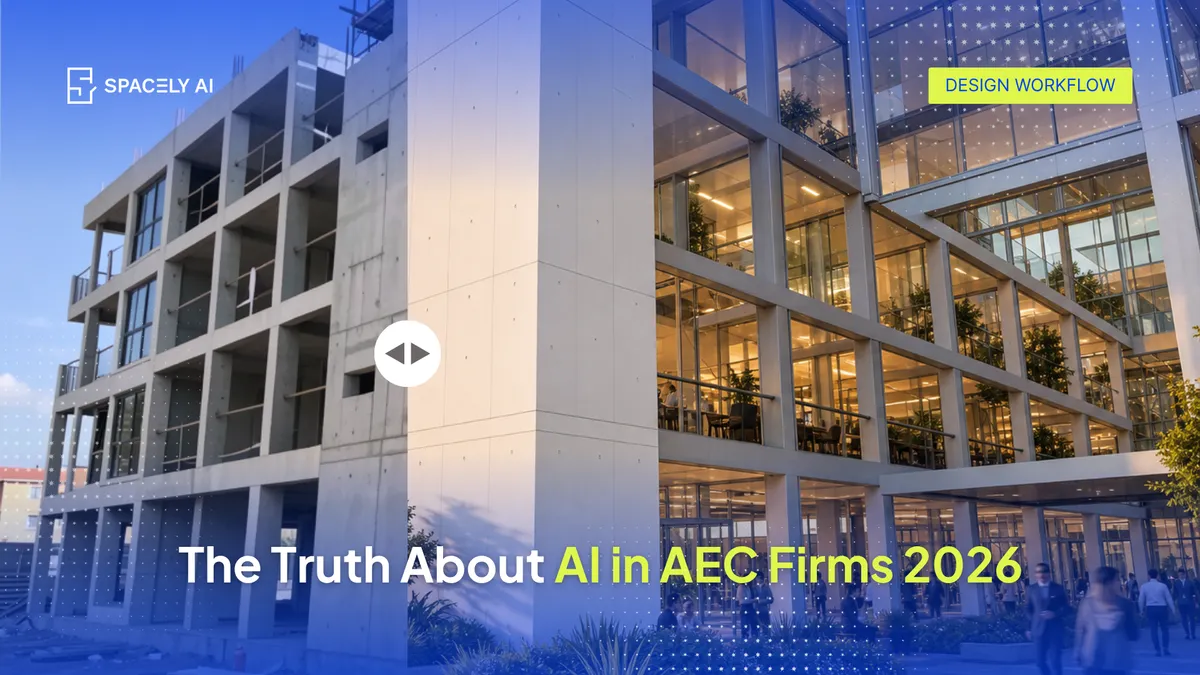
An honest look at where AEC firms actually are with AI and why extensions and plugins that fit existing tools are what really drive adoption.
The honest picture of AI in AEC today is measured, not revolutionary. Most firms are experimenting rather than overhauling, AI is landing first where it carries the least risk whic is concept and visualization process; and the tools that actually stick are the ones that fit the software teams already use, through extensions and plugins, rather than asking a firm to adopt an entirely new platform.
That last part is the quiet truth behind the headlines: adoption follows integration. An AI renderer that runs as an extension inside SketchUp, or a plugin inside Rhino, gets used because it slots into the workflow; one that requires re-modeling a project somewhere else mostly doesn't. Meanwhile, BIM and CAD remain authoritative for documentation. AI hasn't changed that, and the sensible firms aren't asking it to.
Below: where AEC firms genuinely are with AI right now, why extensions and plugins matter more than the model itself, and what realistic adoption looks like. Spacely AI is built as extensions and plugins that meet firms where they already work.
Where are AEC firms actually with AI today?
Cautiously curious: trying things, keeping judgment human. The real state of play is more grounded than the discourse suggests. Plenty of firms are testing AI, most commonly for early visualization and concept work, where a quick photorealistic image helps a client or team react.
Fewer have rebuilt their processes around it, and that caution is reasonable — architecture and engineering carry real responsibility, and firms are right to keep professional judgment, technical accuracy, and accountability with their people.
This isn't reluctance so much as good practice: adopt AI where it clearly helps, keep it away from where precision is non-negotiable, and move deliberately. It's a measured, sensible adoption curve, and there's nothing wrong with that.
Why do extensions and plugins matter more than the AI itself?
Because a tool only helps if it fits the way you already work.
Here's the pattern that separates AI that sticks from AI that gets abandoned: workflow fit. A firm's designers live in specific software — SketchUp for concept, Rhino for complex geometry, Revit for BIM.
An AI renderer delivered as an extension or plugin inside those tools removes friction: you render from the model you already built, in the program you built it in. A standalone tool that asks you to export or rebuild adds steps, and steps are where adoption dies. So when a firm evaluates AI, the model's capability matters less than a simple question — does it run as an extension or plugin in the software we use every day?
That's why Spacely AI ships extensions for SketchUp and Rhino, with AutoCAD and Revit on the way: the goal is to meet firms in their existing workflow rather than beside it.
What does the hype say versus the reality?
| The hype says |
The reality in AEC today |
| AI has replaced designers |
AI speeds concept and visualization; judgment stays with people |
| Firms have overhauled their workflows |
Most are experimenting, deliberately and cautiously |
| You need a whole new platform |
The tools that stick fit existing software via extensions and plugins |
| AI now handles documentation |
BIM and CAD still own documentation and anything buildable |
What does realistic AI adoption look like for an AEC firm?
Start where it's low-risk, keep it in its lane, and keep people in control.
A sensible rollout puts AI at concept and visualization through an extension or plugin in the firm's existing tools, so there's nothing new to learn beyond the render step. Documentation and anything dimensioned stay in BIM and CAD.
Designers start from their own models so renders reflect the real geometry, and the firm keeps the design decisions and technical checks with its architects and engineers. Adopted this way, AI speeds up the parts that were slow — communicating and iterating on a design — without touching the rigor the rest of the project depends on. That's the honest version of "AI in AEC": useful, bounded, and integrated, not a wholesale reinvention.
FAQ
Are AEC firms really using AI yet?
Many are, but mostly for early visualization and concept work rather than a full workflow overhaul. Adoption is measured and cautious, which is sensible given the responsibility involved — firms keep judgment, accuracy, and accountability with their people while using AI where it clearly helps.
Why do extensions and plugins matter for AI in AEC?
Because adoption follows workflow fit. An AI renderer that runs as an extension inside SketchUp or a plugin inside Rhino gets used, since you render from the model you already built. A standalone tool that requires exporting or rebuilding adds friction. Spacely AI ships extensions for SketchUp and Rhino, with AutoCAD and Revit coming.
Does AI replace BIM and CAD in an AEC firm?
No. BIM and CAD remain the authoritative source for documentation and anything dimensioned or buildable. AI fits at the concept and visualization stages to communicate the design faster. The two work together — AI for speed, models for delivery.
More design insights on the Spacely AI blog →
Get started
→ Create your free account
→ Watch the full tutorial on YouTube
→ Explore the member plan
For more information and media inquiries, please contact
Website: spacely.ai
Facebook: facebook.com/spacelyai
Instagram: instagram.com/spacely.ai
Email: [email protected]