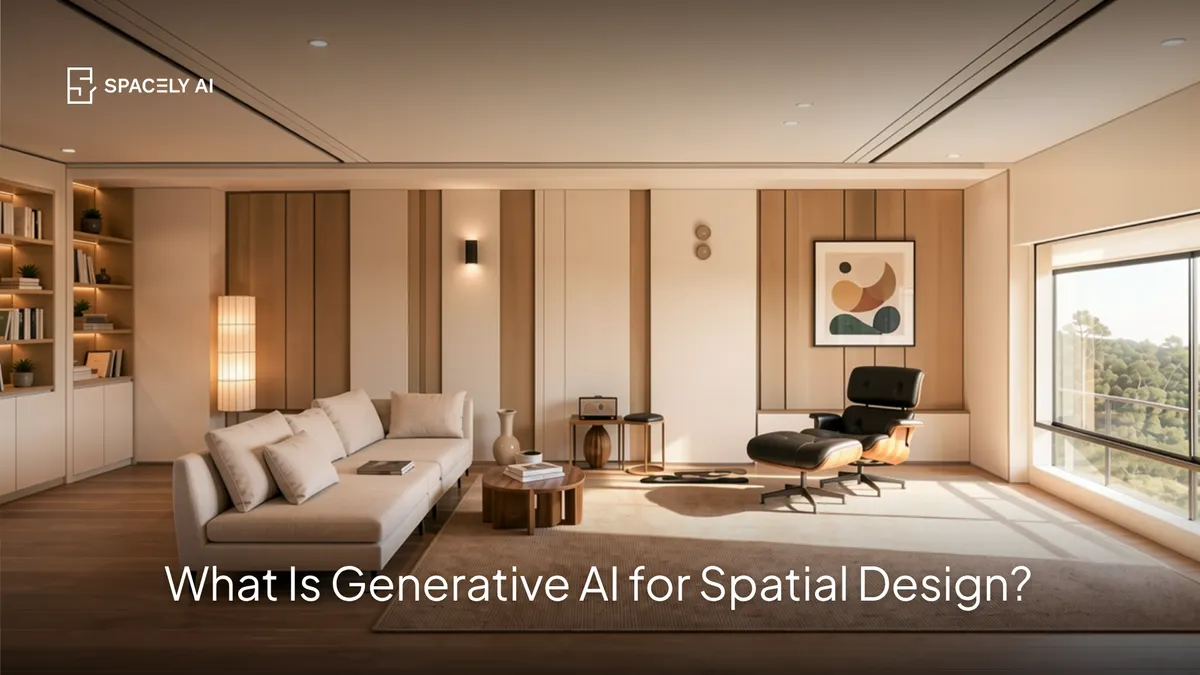
Generative AI for spatial design creates photorealistic images of interior and architectural spaces from a photo, model, or prompt. Here's what it is and how it works.
Generative AI for spatial design is technology that creates photorealistic images of interior and architectural spaces from a photo, a 3D model, or a text prompt — letting designers, architects, and homeowners visualize and iterate on a space in about 60 seconds, instead of hours of manual rendering.
Rather than building a render scene by hand, you give it your space and a description, and it generates the result: a room restyled, a facade rendered, materials and lighting applied, a design option explored. It works across interior design, architecture, and real estate, and it's used for concept exploration, client presentation, staging, and more.
Crucially, it starts from your input, a photo of your actual room or a view of your model, so the output reflects your real space rather than a generic one. Below: what it is, how it works, what it's used for, and where its limits are. Spacely AI is a generative AI platform for spatial design.
What is generative AI for spatial design?
Technology that turns your space and a description into a photorealistic image.
"Spatial design" covers the design of physical spaces like interiors, buildings, rooms. "Generative AI" creates new content from input. Put together, generative AI for spatial design generates realistic images of designed spaces on demand: you provide a photo, a model, or a prompt, and it produces a rendered visualization.
It's the difference between spending hours setting up a render or waiting days for one, and getting a client-ready image in about a minute. It doesn't replace design judgment, it removes the slow production work between having an idea and seeing it.
How does generative AI for spatial design work?
You give it input; it generates a render. The workflow is simple.
You start from a photo of a real space, a view of a 3D model (from tools like SketchUp or Rhino), or a text prompt describing what you want. You add a description: the style, materials, light, and mood, and the AI generates a photorealistic image from it.
When you start from a photo or model, the proportions and layout carry through, so the result is your space, restyled or rendered, rather than an invented one. From there you can iterate: change the style, swap a material, adjust the light, or edit one element, each in about 60 seconds.
What is generative AI for spatial design used for?
Across interiors, architecture, and real estate.
| Field | What it's used for |
|---|
| Interior design | Restyling rooms, testing colors and materials, presenting concepts |
| Architecture | Rendering concepts, facades, and options from a model |
| Real estate | Virtual staging and listing visuals |
| Homeowners | Previewing paint, furniture, and renovations |
| Retail & commercial | Visualizing store, office, and hospitality spaces |
The common thread is speed and accessibility: it makes photorealistic visualization fast and available to people who don't have rendering expertise.
What are the limits of generative AI for spatial design?
It's for visualization, not documentation or measurement. The important boundary: generative AI creates images that communicate how a space looks. It doesn't produce dimensioned drawings, buildable documentation, or engineering analysis. For architects and designers, BIM and CAD remain authoritative for anything measured or construction-bound.
Think of generative AI as the fast visualization layer on top of the design process: excellent for concept, iteration, and communication, while the technical work stays in the tools built for it. Used within that boundary, it's a genuine time-saver rather than a risk.
The bottom line
Generative AI for spatial design creates photorealistic images of interior and architectural spaces from a photo, model, or prompt — turning a design idea into a client-ready visual in about 60 seconds. It's used across interior design, architecture, and real estate for concept exploration, presentation, and staging, and it works best when it starts from your own space or model. Keep it to visualization, leave documentation to BIM and CAD, and it becomes one of the fastest, most accessible tools in design. Spacely AI is built for exactly this.
FAQ
What is generative AI for spatial design? It's technology that generates photorealistic images of interior and architectural spaces from a photo, a 3D model, or a text prompt. It lets designers, architects, and homeowners visualize and iterate on a space in about 60 seconds instead of rendering by hand, and it works across interior design, architecture, and real estate.
How does generative AI for spatial design work? You start from a photo, a model view, or a prompt, add a description of the style, materials, and light, and the AI generates a photorealistic image. Starting from a photo or model keeps the proportions true, so the result reflects your actual space. You can then iterate, restyle, swap materials, or edit an element — each in about 60 seconds.
What are its limits? It creates images that communicate how a space looks, but it doesn't produce dimensioned drawings, buildable documentation, or engineering analysis. BIM and CAD stay authoritative for anything measured or construction-bound. It's best used as a fast visualization layer for concept, iteration, and communication.
More design workflow insights on the Spacely AI blog →
Get started
→ Create your free account
→ Watch the full tutorial on YouTube
→ Explore the member plan
For more information and media inquiries, please contact
Website: spacely.ai
Facebook: facebook.com/spacelyai
Instagram: instagram.com/spacely.ai
Email: [email protected]