News
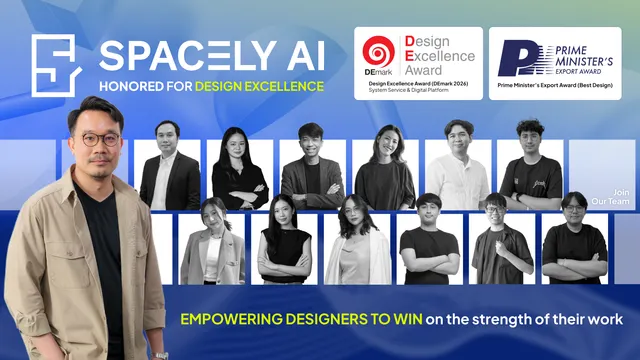
Two National Design Awards. One Thank You.
Spacely AI has been honored with two national design awards in Thailand. We took first place in the DEmark 2026 — Design Excellence Award, in the System Service…
Paphada Vasinsittisuk3 min read

Spacely AI has won the Creative Business Award at the CEA Creative Excellence Awards 2026. Here's the problem we set out to fix and what we learned from 100+ design firms.
Ask a designer how much of their week is spent designing, and you'll get an uncomfortable answer. Roughly 20% of it is thinking — the part that requires judgment, taste, and years of trained instinct. The other 80% is doing. Drawing the floor plan again. Hunting for a 3D model of a refrigerator. Rearranging furniture in a viewport. Watching a render climb from pass 12 to pass 56 while a client waits.
That ratio is the reason Spacely AI exists. And this month, it's the reason we're able to share some news: Spacely AI has received the Creative Business Award at the Creative Excellence Awards 2026, presented by the Creative Economy Agency (CEA).
We want to use this post to explain what we were actually recognized for because it isn't rendering speed. It's a design decision we made early and have refused to move away from.
Before we wrote a line of product code, we interviewed more than 100 design and architecture firms across Asia, Europe, and North America. We expected regional differences. We found one shared global pain instead, and it broke down into three parts:
None of those three are creative problems. They're production problems sitting on top of creative work.
The first generation of generative AI tools asked designers to describe a room in a paragraph. That is not how designers work. A designer doesn't write a paragraph about a vase, they point at the vase and swap it.
| Text-driven (AI behavior) | Text-driven (AI behavior) | Visual-driven (designer behavior) |
|---|---|---|
| Input | Long written prompt | Reference image, mask, material swatch |
| Revision | Rewrite the prompt, regenerate everything | Select one element, change only that |
| Control | The model interprets | The designer decides |
| Learning curve | Prompt engineering | The instincts they already have |
Spacely AI sits in the overlap between what AI does well and what designers do well. AI handles production. The designer keeps creative judgment. That boundary is the product.
Our team ran the build as a design process, not a feature race.
That last line is the one we're proudest of. Spacely AI works inside the workflow designers already have, including a plugin that runs alongside SketchUp, so a model can go from viewport to client-ready visual without exporting into an unfamiliar environment. It runs in a browser. Mobile is supported. No high-end GPU required.
Once production stops being manual, the three constraints invert. And the ratio we started with flips too. Spacely AI takes on roughly 20% of the project, the production work. The designer gets the other 80% back for thinking.
| Constraint | Before | With Spacely AI |
|---|---|---|
| Time | Manual, days per deliverable | Client-ready renders in under 3 minutes |
| Cost | ~$150 per outsourced render | A monthly subscription covering hundreds of renders |
| Quality | Limited by hardware and deadline | Presentation-quality 4K output, revised as many times as the project needs |
The CEA Creative Business Award recognizes businesses that apply creativity to generate economic and social value for Thailand. We think spatial design tooling belongs in that conversation for a specific reason.
Thailand's creative economy is usually discussed in terms of exported craft, food, film, and culture. Software is the less obvious export, but it scales differently. A tool built in Bangkok now serves 580,000+ designers across 50+ countries, with over 2 million spaces rendered.
Every one of those designers is making decisions about how people will live, work, wait, heal, and move through space. Which brings us back to the ratio.
Good design is where every solution starts. If designers only get 20% of their time to think, the ceiling on what gets designed is set by production capacity rather than by imagination. Move that number and you don't just make studios more profitable, you change what's possible to design at all.
To CEA, thank you for the recognition. To the designers who sent us bug reports, feature requests, and projects they were proud of: this is your award more than ours.
Let designers design.
For more information and media inquiries, please contact
Website: spacely.ai
Facebook: facebook.com/spacelyai
Instagram: instagram.com/spacely.ai
Email: [email protected]
Spacely AI has been honored with two national design awards in Thailand. We took first place in the DEmark 2026 — Design Excellence Award, in the System Service…
Spacely AI is joining the SketchUp 3D Summit 2026 in Denver, June 17–19. Learn SketchUp, AI, and workflow updates from industry leaders on-site, live-streamed,…
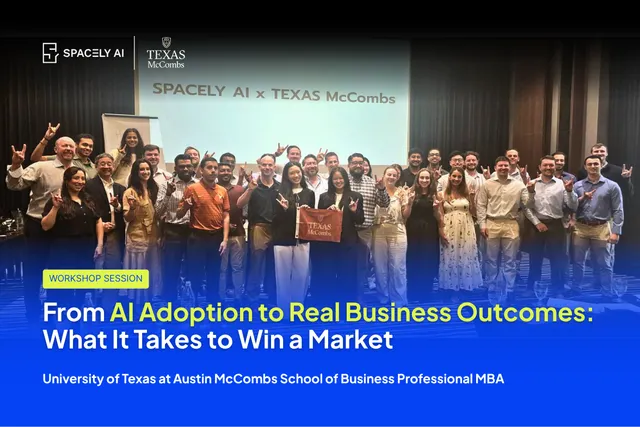
Spacely AI ran a go-to-market workshop with University of Texas, Austin McCombs Professional MBA. Here's what an open brainstorm taught us about US market entry…